

An empty nest support group is a place where parents whose children have left home talk honestly about what that change feels like, with people who are living it too. Some groups are peer-led and free, some are social, some are run by therapists for a fee, and some live online. The right one depends on whether you want company, practical ideas, or real clinical help. This guide explains each type, what a first meeting looks like, and how to tell a good group from a poor fit.
TL;DR
- An empty nest group can be peer-led, social, therapist-facilitated or online. Peer groups are not therapy, and that is fine for many people.
- Research on empty nest couples found both hardship and real upsides, so mixed feelings are normal, not a sign something is wrong.
- Judge a group on safety, relevance and moderation: clear rules, respectful listening, and someone who steps in when things go sideways.
- Persistent distress that disrupts daily life is a reason to see a licensed professional, not only to join a group.
- You can start small: one regular coffee, one online community, one class.
Table of Contents
- What an empty nest support group actually is
- What empty nesters are really dealing with
- The main types of groups
- What to expect at your first meeting
- How to tell whether a group is safe and a good fit
- Coping outside the group
- When a group is not enough
- Our perspective
- Find your people at The Reset
- Frequently asked questions
- Sources
What an empty nest support group actually is
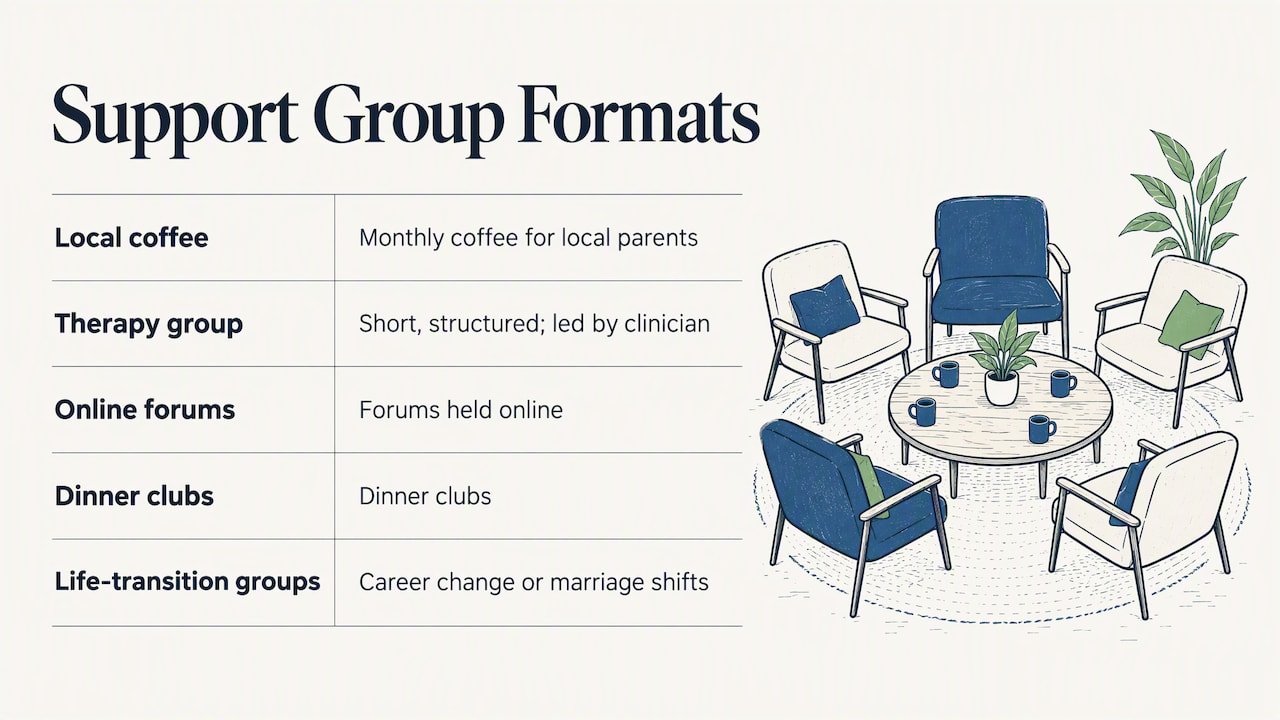
The name covers a lot of ground. At one end is a monthly coffee for local parents whose kids have grown up. At the other is a short, structured therapy group led by a licensed clinician. Between them sit online forums, dinner clubs, and communities built around a broader life shift, such as a career change or a new marriage dynamic.
What they share is a simple premise: you do not have to work out this stage alone. Hearing someone else say the quiet house feels strange, or that they are surprisingly relieved, takes the pressure off. You stop wondering whether your reaction is the right one.
It helps to know the difference between peer support and treatment. HelpGuide explains that mutual-support facilitators are trained but do not act as professional advisers, though some groups invite doctors, therapists or other specialists as guest speakers. So a peer group offers shared experience and accountability. It does not diagnose or treat anything.
What empty nesters are really dealing with
People often expect sadness and little else. The research paints a more mixed picture.
A study by Nagy and Theiss published in 2013 interviewed 50 couples whose last or only child had left within the previous 18 months. Couples described both relational hardship and improvement. The difficult themes were uncertainty about new roles, dependence on a partner, restoring intimacy, and thoughts about mortality. The positive ones were more time together, more freedom, better communication, more privacy, and a sense of a new beginning.
The American Psychological Association’s September 2026 report on empty nesting describes two frameworks. Under role loss, parents may feel a loss of identity and distress. Under role relief, they may feel relief and gain time for other pursuits. Many people feel both in the same week.
A good group makes room for all of it. If you walk in grieving, nobody should tell you to cheer up. If you walk in thrilled and a little guilty about it, nobody should tell you that you are cold.
In practice, the topics that come up again and again include:
- Loneliness in a house that used to be loud.
- A marriage or partnership that now has no buffer.
- Not knowing who you are when the daily work of parenting is gone.
- How much to contact an adult child, and how to support them from afar.
- What to do with the next twenty or thirty years, including work.
The main types of groups
Peer-led support groups
These are run by members or trained volunteers. Meetings usually follow a loose structure: a welcome, a chance for each person to speak, and a close. They are often free or low cost, and they can be local or online. The strength is lived experience. The limit is that no one is there to treat depression, anxiety or relationship conflict.
Social groups and dinner clubs
Some of the most useful groups never call themselves support groups. A first-person account on SheKnows from 2024 describes parents who started recurring empty-nester dinners after noticing that friends at the same life stage needed a safe place to share feelings. The author says the group talked about loneliness, marriage, divorce, career pivots, yoga, job leads, cultural activities, and supporting adult children from a distance. It is one person’s story, not data, but it shows how a plain meal and regular company can do real work.
If formal “sharing” makes you wince, start here.
Therapist-facilitated groups
These are time-limited and structured, often with a fee and a set number of sessions. They suit people who want guided tools along with company. The evidence is encouraging but modest and comes mostly from small studies in one country:
- A 2017 Iranian quasi-experimental study found that eight consecutive 90-minute group sessions based on acceptance and commitment therapy significantly raised life-satisfaction scores compared with a control group of people with empty-nest syndrome.
- A 2013 Iranian study reported that group cognitive-behavioral therapy reduced depression and increased hope among 24 empty-nest parents, compared with a control group.
- A clinical trial of 75 postmenopausal women with empty-nest syndrome found that six weekly 90-minute solution-focused counseling sessions produced a statistically significant improvement in happiness. The sessions covered defining problems and goals, spotting exceptions and strengths, imagining the future, and reviewing assignments.
These samples are small, and cultural context matters, so treat them as a sign that structured group work can help, not as a promise of results.
Online communities
Online groups are open at 2 a.m. and do not depend on where you live. That matters if you are in a small town, work odd hours, or feel exposed showing up in person. The tradeoff is quality: online spaces vary enormously in how well they are moderated, which brings us to choosing.
What to expect at your first meeting
First meetings are less intimidating than people fear. According to HelpGuide, a well-run group usually starts with a facilitator’s welcome, gives each person a chance to introduce themselves, moves into discussion, and ends with a formal close.
A few things to know going in:
- You choose how much to share. The facilitator should explain the ground rules, and a pass is commonly allowed. Listening during your first session is a perfectly good way to take part.
- Confidentiality and respectful listening are central. HelpGuide notes that legal reporting exceptions can apply, so ask the facilitator what the limits are if you are concerned.
- Expect to feel awkward. That fades. Most people say the second visit is easier than the first.
- You can leave. One meeting is a trial, not a commitment.
Before you go, write down one thing you hope to get: company, ideas, a place to vent, or tools for a specific struggle. It makes it easier to judge afterward whether the group delivers.
How to tell whether a group is safe and a good fit
A friendly name is not enough. Research on online peer support points to what matters. A 2024 realist synthesis from Lancaster University of 102 evidence sources and 18 staff interviews found that psychological safety and personally relevant content underpin engagement. Welcoming, non-judgmental communities can reduce isolation and normalize experiences, and moderators help limit distressing content. In other words, a space works best when it is safe, relevant and actively moderated, not merely available.
A 2026 JMIR analysis adds that members and moderators saw effective moderation as critical for safety and engagement, especially against misinformation. It recommends clear escalation routes, transparent communication, evolving policies, and support for moderators.
Turn that into a checklist:
| What to look for | Good sign | Warning sign |
|---|---|---|
| Ground rules | Posted or stated up front | Nothing written, rules enforced randomly |
| Moderation or facilitation | Someone visibly guides conversation and handles conflict | Arguments left to run, advice-giving as a contest |
| Relevance | Members are at your life stage or facing similar questions | Topics drift far from what you came for |
| Tone | Mixed feelings welcome, no pressure to be upbeat | Judgment about how you “should” feel |
| Medical claims | People share experience and point to professionals | Members diagnose or push treatments |
| Privacy | Clear confidentiality expectations | Screenshots and gossip tolerated |
Also consider fit beyond safety. A group of newly retired couples may feel wrong if you are a single parent still working full time. A group centered on grief may drain you if what you want is energy and a plan. Try two or three before deciding.
Coping outside the group
A group is one tool. Daily structure and contact with people count too. The National Institute on Aging’s tips for staying connected include restarting an old hobby, taking a class, scheduling regular contact with trusted people, exercising with others, volunteering, and pursuing meaningful activities that create purpose.
The Nagy and Theiss researchers also suggested supports such as workshops on common reactions and coping skills and structured leisure activities, which hints that a mix of company and shared activity may help more than talking alone.
Practical ways to start this month:
- Put one recurring thing on the calendar, such as a weekly walk with a friend or a class that meets at a set time.
- Pick one project you shelved for years and give it two hours a week.
- Decide in advance how often you and your adult child will talk, so the calls feel good instead of anxious.
- If work is part of the question, treat it as a design problem rather than a verdict on your worth.
When a group is not enough
Support groups are not a substitute for care when you are struggling badly. Healthline says individual therapy may be a good next step if ongoing distress disrupts everyday life. Signs include difficulty enjoying usual activities, connecting with loved ones, or managing basic self-care, as well as regret or resentment, partner conflict, or a feeling that life has no meaning.
If that sounds like you, talk to your primary care doctor or a licensed therapist, and consider couples counseling if the strain is between you and your partner. If you are in acute distress or having thoughts of harming yourself, Healthline advises contacting the 988 Suicide & Crisis Lifeline. In the United States, you can call or text 988 at any time.
Our perspective
We talk to a lot of people who are starting over, and the empty nest belongs in that conversation. It is a transition like a layoff or a divorce: an old role ends, the calendar empties, and the question “who am I now?” arrives before anyone has an answer.
What we have seen is that the hardest part is rarely the logistics. It is feeling isolated in the uncertainty, assuming everyone else has moved on gracefully. Generic advice does not touch that. Hearing from someone who has been through it does.
So we would push back on two ideas. One is that the empty nest is only a loss to be endured. The other is that it is only a freedom to be celebrated. Most people live in between for a while, and that is allowed. Treat the in-between as the start of something, not a verdict on the years before it.
If you do one thing after reading this, make it small and social: one group, one meeting, one conversation with someone who gets it.
— Melanie
Find your people at The Reset
Our community is built for people going through transitions, including career changes, burnout, divorce, and the shift to a quieter home. You will find member stories, practical guides, and peer support from people reinventing their lives, rather than top-down coaching. If you are thinking about what comes next for your work or your days, start with our overview of The Reset.
If you want a step-by-step place to begin, our guide on how to reinvent yourself walks through seven steps to starting over. Readers in midlife may also like resetting your life after 40.
Frequently asked questions
Is an empty nest support group the same as therapy?
Not usually. Peer-led groups run on shared experience, and facilitators are trained but are not professional advisers. Therapist-led groups are a different format, with licensed clinicians and a set number of sessions. If your distress is affecting daily life, individual counseling is worth considering alongside or instead of a group.
Do I have to speak at my first meeting?
No. A good facilitator explains the rules at the start, and passing is commonly allowed. Many people spend the first session listening and share once they feel comfortable. If you feel pressured to disclose, that is a reason to look elsewhere.
Are online empty nest groups worth it?
They can be, especially if you live far from in-person options. Research on online peer support finds that safety, relevance and active moderation are what make them work. Check for posted rules and visible moderators before you share anything personal.
Is it normal to feel relieved instead of sad?
Yes. Studies of empty nest couples found both difficulties and positives such as more freedom, more couple time and a sense of a new beginning. The APA’s 2026 report describes parents feeling role loss, role relief, or both. Mixed feelings are common.
What if there is no group near me?
Start your own small version. A monthly coffee or dinner with two or three other parents in the same stage can work as a social support group. Online communities and classes with regular meeting times are good alternatives.
Sources
- Applying the Relational Turbulence Model to the Empty-Nest Transition (Nagy and Theiss, 2013)
- The many pathways of empty nesting, American Psychological Association
- Effectiveness of group therapy based on commitment and acceptance, 2017
- Impact of group cognitive behavioral therapy on empty-nest parents
- Effect of solution-focused group counseling on postmenopausal women with empty-nest syndrome
- Coping With an Empty Nest Became Easier When I Found a Group, SheKnows
- Support Groups: Types, Benefits, and What to Expect, HelpGuide
- Understanding the Impacts of Online Mental Health Peer Support, Lancaster University
- Journal of Medical Internet Research, 2026 analysis of online peer moderation
- Loneliness and Social Isolation: Tips for Staying Connected, National Institute on Aging
- Empty Nest Syndrome: Possible Effects and How to Cope, Healthline
