

This post contains affiliate links. As an Amazon Associate I earn from qualifying purchases. Read my full affiliate disclosure.
Quick answer: The Everyday Mental Wellness Companion is a free, 17-page printable PDF workbook with small, flexible tools for stressful seasons: a two-minute check-in, calm-in-the-moment techniques, boundary scripts, a support map, a 14-day gentle reset and seven printable worksheets. You can download it below and start with just one page.
After my layoff, the hardest part wasn’t the job search. It was the noise in my head. Some days I needed a plan; other days I just needed a way to get through the next hour. This workbook is the kind of thing I wish I’d had on the kitchen table back then: gentle, practical and built for real life, not a perfect routine.

What is The Everyday Mental Wellness Companion?
Short answer: It is a practical guide plus printable workbook focused on small steps toward calm, confidence and emotional balance. It is for education and self-reflection, not diagnosis or treatment.
Its opening idea is one I needed to hear: there is no perfect way to care for yourself. You start with one manageable idea, notice what happens and adjust it to fit your life. You can read one chapter at a time or jump straight to a worksheet.
What’s inside the free workbook
- Mental wellness without perfection: a two-minute personal check-in and a weekly intention.
- Stress, anxiety and burnout: a simple table of body, thought, behavior and energy signals, with a small response for each.
- Your daily foundation: low-effort morning, midday, afternoon and evening options, plus a one-habit experiment.
- Calm-in-the-moment tools: sensory grounding, easy-paced breathing, changing your surroundings and “name, notice, choose.”
- Self-talk, boundaries and relationships: kinder alternatives to harsh thoughts and clear boundary sentences.
- Your support map: who listens, who helps practically, professional support and low-pressure connection.
- A 14-day gentle reset with one small action per day.
- Seven printable worksheets: daily check-in, stress pattern log, thought reframe, week-at-a-glance, boundaries and energy, my support plan, and a nature and seasonal reset.
How to use the 14-day gentle reset

Short answer: Do one small action a day for 14 days. The workbook calls these “small experiments, not a rigid challenge,” so if a day is difficult you rest or repeat an earlier practice.
The days build gently: notice your mood without rating your worth, choose one supportive morning action, take a short movement break, try a grounding exercise, make one request or set one boundary, spend time near natural light, reach out to someone you trust, and on Day 14, choose one habit to carry forward. My favorite line on the page: “A missed day does not erase anything. Start again wherever you are.”
If you like the idea of tiny steps: Tiny Habits by BJ Fogg goes deeper on the same “tie a new habit to something you already do” approach the workbook uses for habit pairing.
Calm tools for anxious moments
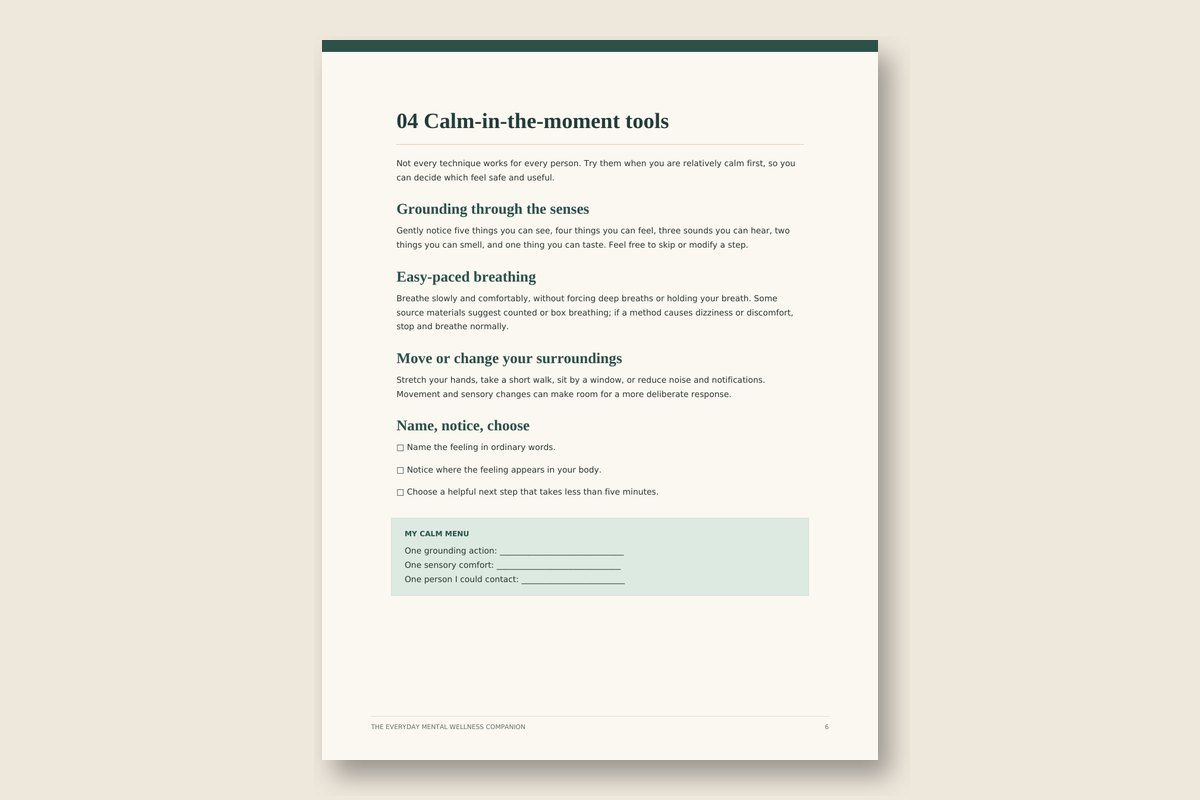
The workbook suggests trying these when you’re relatively calm first, so you can learn which ones feel safe and useful for you. Not every technique works for every person.
- Grounding through the senses: five things you see, four you feel, three you hear, two you smell, one you taste. Skip or change any step.
- Easy-paced breathing: slow and comfortable, without forcing deep breaths. If anything makes you dizzy, stop and breathe normally.
- Move or change your surroundings: stretch, walk, sit by a window or turn off notifications.
- Name, notice, choose: name the feeling, notice where it shows up in your body, then pick a next step that takes under five minutes.
If anxiety has been loud lately: The Anxiety and Phobia Workbook by Edmund J. Bourne, PhD, is a longer, well-known workbook with many more exercises to work through at your own pace.
Boundaries that protect your energy
When you’re rebuilding, people mean well and still ask a lot. The workbook offers simple sentences like “I can’t take that on this week” and “I’m available to talk tomorrow, but I need to rest tonight,” plus a worksheet for writing your own respectful script.
If saying no is hard for you (it was for me): Set Boundaries, Find Peace by Nedra Glover Tawwab walks through how to set and keep healthy limits with family, friends and work.
The printable worksheets

The daily check-in asks how you feel, what your body is telling you, what might be contributing, and the smallest supportive thing you can do next. The stress level rating is optional. Like every tracker in the workbook, use it only if it helps.
Who this workbook is for
If you just lost a job, feel burned out, or are simply carrying a lot, this is for you. It pairs well with my guide on how to reset your life when you’re burned out and overwhelmed and with the free tracker in my practical 30-day reset plan after a layoff. If you’re still in the early days, starting over after losing your job may help too, and if work itself is the problem, read what to do when you hate your job.
When to reach out for more help
The workbook is clear about this, and so am I: if sadness, fear, loss of interest, sleep changes or distress keep going or start to disrupt your responsibilities or relationships, consider talking with a qualified professional. Some physical symptoms can also have medical causes. If you’re thinking about self-harm, please reach out for immediate support rather than handling it alone.
Crisis support: In the United States, call or text 988 for the Suicide & Crisis Lifeline. For immediate physical danger, call 911 or your local emergency number. Outside the U.S., use your local crisis service.
Frequently asked questions
Is The Everyday Mental Wellness Companion really free?
Yes. It’s a free 17-page PDF you can download from this post, print at home or fill in on paper. There’s nothing to sign up for.
What’s inside the workbook?
Eight sections: mental wellness without perfection, understanding stress, anxiety and burnout, a daily foundation of small habits, calm-in-the-moment tools, self-talk and boundaries, a support map, a 14-day gentle reset, and seven printable worksheets.
Is this workbook a substitute for therapy?
No. It’s an educational self-reflection resource, not a diagnosis or treatment plan, and it isn’t a substitute for a qualified healthcare professional. I’m not a clinician; I’m sharing tools that helped me feel steadier.
How do I use the 14-day gentle reset?
Do one small action a day, like noticing your mood, taking a short movement break or reaching out to someone you trust. If a day is hard, rest or repeat an earlier practice. A missed day doesn’t erase anything.
Do I have to fill in the trackers?
No. The workbook says tracking tools are optional. If recording how you feel makes you more distressed, skip the tracker and focus on support instead.
What should I do if I’m in crisis?
In the United States, call or text 988 for the Suicide & Crisis Lifeline. For immediate physical danger, call 911 or your local emergency number. Outside the U.S., use your local crisis service.
Start with one small step
You don’t need to overhaul your life in a weekend. Print one page, try one practice, and see how it feels. As the workbook says, a small step, a supportive connection or a well-timed request for help is a meaningful place to begin.
This post and workbook are for education and self-reflection only. I’m not a licensed healthcare professional, and nothing here is medical or mental health advice, diagnosis or treatment.
