

A sabbatical is an extended, intentional break from your regular work, usually with your job or position waiting for you at the end. It can last a few weeks or a couple of years, it can be paid, partly paid or unpaid, and it is meant for something that your routine job doesn’t leave room for: rest, study, travel, research, a creative project or a rethink of where your career is heading. Harvard Business Review puts it simply: to take a sabbatical is to take intentional, extended leave from job-related work.
That’s the short version. The longer one matters, because the word means different things at a university, at a company and in everyday conversation, and the difference decides whether you get paid, whether you can come back and what you owe your employer afterward.
TL;DR
- A sabbatical is a long, purposeful leave from work, traditionally for teachers and professors, now also offered by some employers and used loosely for any planned time out.
- Typical length runs from about one month to two years. Pay can be full, partial or zero, depending on the employer, your tenure and the purpose of the leave.
- A true sabbatical is agreed with your employer and keeps your job open. A career break usually means you resign and re-enter the job market later.
- In the US there is no general legal right to a sabbatical. It depends on your employer’s policy or an agreement you negotiate.
- Decide your purpose, price it out, and settle the return terms in writing before you leave.
Table of Contents
- What the word actually means
- Sabbaticals in academia versus the workplace
- How long a sabbatical lasts and whether it’s paid
- Do you keep your job?
- Sabbatical vs. career break
- What people do on a sabbatical
- Does a sabbatical actually help?
- How to plan one: a practical sequence
- Our perspective
- Where The Reset fits in
- FAQ
- Sources
What the word actually means
The word traces back to the Sabbath, the day of rest. The old academic custom was a year away from teaching roughly every seventh year, and that image still shapes how people think of the term. Cambridge Dictionary describes the traditional sense as time when college or university teachers stop their usual work to study or travel, typically while continuing to be paid. Its workplace sense is broader: a period when an employee takes time away from work to study or travel.
Dictionary.com gives the widest reading: any extended period of leave from customary work, especially for rest, for acquiring skills or training, or for similar purposeful activity.
Put those together and you get three features that define a sabbatical in practice:
- It is extended. Weeks at the very least, usually months.
- It is intentional. There’s a purpose, even if the purpose is simply to recover.
- It is a leave, not a goodbye. You are still connected to your employer or institution and expect to return.
That third point is what separates a sabbatical from quitting to travel. We’ll come back to it.
Sabbaticals in academia versus the workplace
In universities, sabbaticals are a formal part of the faculty career. They’re usually tied to years of service and a proposal describing what you’ll do. The University of South Florida’s sabbatical guidelines treat the leave as professional development: renewal, planned travel, study, education, research, writing or another professionally valuable experience, not just a reward for time served.
Outside academia, sabbaticals are an employer perk, and a minority one. Some companies offer them after a set number of years, often a few weeks or a few months. Others have no policy at all, and employees negotiate an unpaid leave case by case. A manager who has seen you deliver for years may be more flexible than the handbook suggests, but you should never assume it.
The term has also drifted into everyday speech. Writer Dana Miranda notes that people use it for everything from a few weeks off a corporate job to a student’s gap year. That looseness is why so many people search for the meaning: the same word covers a faculty research year and a self-funded six months in Portugal.
How long a sabbatical lasts and whether it’s paid
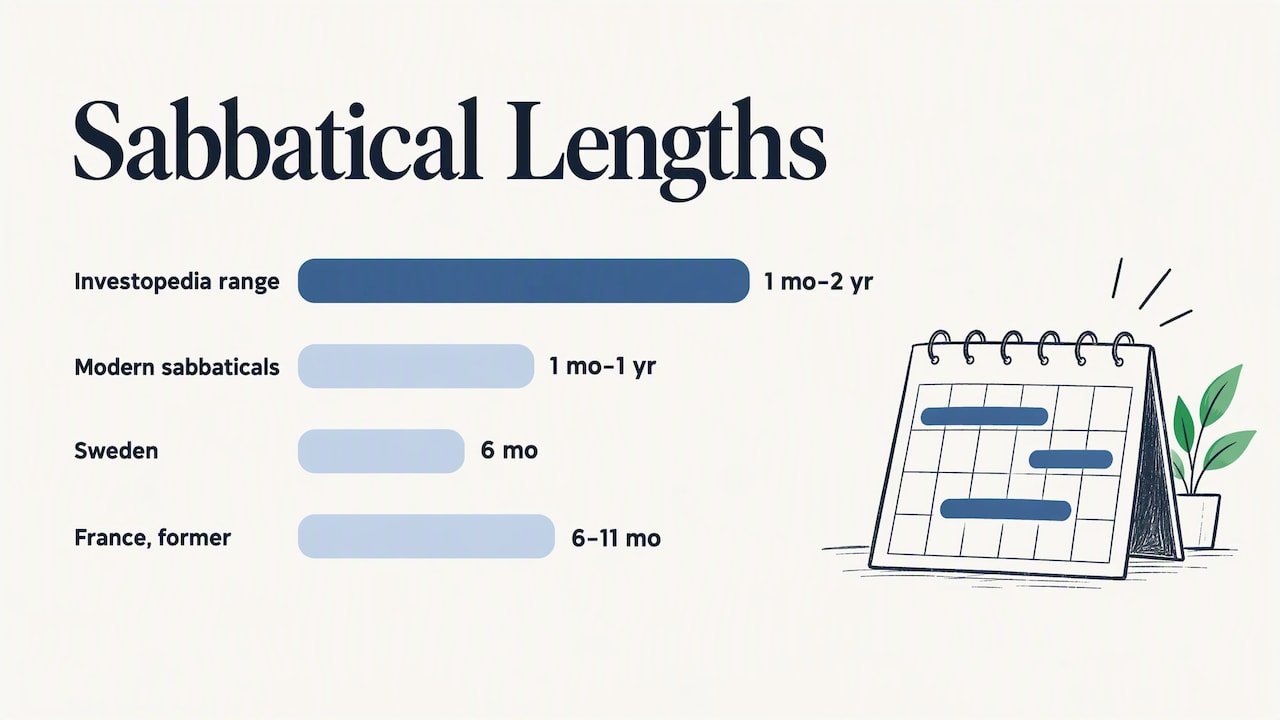
There is no universal standard. Investopedia describes sabbaticals as lasting from one month to two years, with employees remaining employed and typically receiving full or partial salary, although the leave may be unpaid. It adds that pay depends on tenure, position and the nature of the leave. Built In reports that modern workplace sabbaticals commonly run about one month to one year.
University policies show how the money usually works. Pay and time trade off against each other:
| Institution | Eligibility | Options |
|---|---|---|
| Penn State | Eligible faculty | A full contract year at 67% salary, or half a contract year at 100% salary, with proportional arrangements for other periods |
| Boston University School of Public Health | After at least six years of full-time service | Half a year at full salary, or a full year at 50% salary |
| University of South Florida | Eligible employees | Two semesters at half pay, with at least one full-pay semester for every 25 eligible employees |
The pattern is consistent: the longer you’re away, the smaller the paycheck. If you’re planning a corporate sabbatical, expect to see a version of that trade-off, or no pay at all.
The rules also change from country to country. The Globe and Mail reported that Sweden provides six months of unpaid leave for study or an entrepreneurial project with job protection, while Australia provides paid long-service leave after seven to ten years with the same employer. An older version of France’s Labour Code gave eligible employees six to eleven months of sabbatical with the employment contract suspended. In the US, by contrast, you won’t find a comparable statutory entitlement, so everything rests on your employer’s policy and your own negotiation.
Do you keep your job?
Usually, yes, and that’s the point of the arrangement. A mutually agreed sabbatical doesn’t require you to resign, and it assures a position at the company when you come back.
Three cautions matter here.
Return obligations. Many formal policies attach strings. Penn State requires a full contract year of service after the sabbatical and can require repayment of sabbatical salary if you don’t return or don’t stay that long. USF’s guidelines likewise ask participants to return for at least one academic year afterward, and salary may have to be repaid if they don’t. A paid sabbatical is often a loan against your future loyalty.
The job may change. Investopedia cautions that even when your job is guaranteed, your functions may differ when you come back. “Guaranteed” can mean a position, not the exact desk and projects you left.
No general entitlement. A UK employment-law firm, rradar, points out that a sabbatical is generally a formal arrangement in which the worker stays employed, and that entitlement depends on the employment contract, with no general legal right. The same logic holds in the US: get the terms on paper.
Sabbatical vs. career break
People mix these up constantly, and it matters because the risks are different.
| Sabbatical | Career break | |
|---|---|---|
| Relationship with employer | Agreed with your employer; you stay employed | Often means resigning or giving notice |
| Return | A role or position awaits you on a set date | You search for a job afterward |
| Pay | Paid, partly paid or unpaid | Typically unpaid |
| Typical length | About a month to two years | Often six months to a year |
The sabbatical is the safer version, but it requires an employer willing to hold your place. If yours isn’t, a career break is a legitimate choice, as long as you budget for the job search at the other end. If you’ve been pushed out rather than choosing to leave, you’re in a different situation altogether, and our guide to starting over after losing your job is a better place to begin.
What people do on a sabbatical
There’s no required itinerary. Typical uses include rest, learning, travel, volunteering, skill-building, time with family and reflection on personal goals. Workday describes a modern sabbatical as an extended, structured break used to rest, learn, travel or pursue a passion.
Research gives a more useful map. A Harvard Business School study summary drawn from 50 diverse professionals found that sabbaticals combine recovery, exploration and practice, and identified three typical trajectories:
- Working holidays. These people tend to return to their former lives with more confidence and a stronger need for balance.
- Free dives. These people pursue work that fits better but looks similar to what they did before.
- Quests. These people are the most likely to make drastic career changes.
None of these is the right one. But knowing which you’re after changes how you plan. If you want a rested version of your current life, a short leave and a firm return date is enough. If you suspect you want a different career, you’ll need a longer runway, money to survive a transition and probably a willingness to let the return date become optional.
Sabbaticals are also not pure vacation. As Miranda writes, a sabbatical isn’t complete rest. Many people find the first weeks are about unwinding, and the useful thinking comes later.
Does a sabbatical actually help?
The evidence is encouraging, with limits. A large German panel study covering 2002 to 2013 found that sabbaticals significantly raised job satisfaction and leisure satisfaction and lowered employees’ intention to leave. It found no significant health effect once individual differences were controlled for. In other words, a sabbatical can improve how you feel about your work and your time, but it won’t necessarily fix a health problem on its own.
DJ DiDonna of Harvard Business School, writing in Harvard Business Review, presents the value as uninterrupted time that supports recovery, reflection and sometimes a changed professional direction. Kira Schabram of the University of Washington’s Foster School of Business argues that the distinctive value is a potential transformation in your relationship with work, not merely a recharge before you return unchanged.
If you’re burned out, a sabbatical is one tool, not the only one. Our guide to recovering from burnout covers the steps you can start before you ever get leave approved.
How to plan one: a practical sequence
The advice from Indeed comes down to four moves: decide the purpose, plan the terms, save money and talk openly with your employer. Here’s how that looks in practice.
- Name the purpose in one sentence. “Recover from three years of overwork” and “test whether I can run my own business” lead to different plans. If you can’t write the sentence, you’re not ready to ask.
- Check whether a policy exists. Look in the handbook or ask HR. If there’s one, read the eligibility years, pay structure and return obligations. If there isn’t, you’ll be proposing an arrangement.
- Price the time off. Investopedia advises saving enough to cover living expenses, because otherwise you may end up using regular or retirement savings and adding to your debts. Work out monthly costs, health insurance and any lost benefits, then add a cushion. Our guide to financially resetting your life walks through building that budget.
- Make the proposal easy to say yes to. Offer a start date, an end date, a handover plan and a way to be reached for true emergencies. Managers say no to vague requests and yes to specific ones.
- Get it in writing. Confirm length, pay, benefits, the position you’ll return to and anything you’d owe if you leave afterward.
- Plan the re-entry. Decide how you’ll spend your first week back, and what you’ll do if the sabbatical shows you the job no longer fits.
That last point deserves attention. A sabbatical sometimes ends with a decision to change course. If that’s you, how to reinvent yourself lays out a seven-step path, and if you’re past your early career, resetting your life after 40 speaks to that stage specifically.
Our perspective
We hear the same thing from people who come to The Reset: they didn’t need a perfect plan, they needed permission to stop and think. A sabbatical is a formal version of that permission. What we’d add is that the structure matters less than the company you keep during it.
Most people who take extended time away feel isolated. Colleagues don’t understand why you’d leave a good job. Friends assume you’re on vacation. Family worries about money. The leave itself may be well designed, and you can still spend weeks wondering whether you’re making a mistake. Talking to people who’ve done it, or who are in a similar in-between place after a layoff, a divorce or a burnout, takes much of that weight off.

We also think the money question gets too little honesty. A sabbatical is easiest for people with savings, a flexible employer and a supportive household. If that isn’t you, a shorter leave, a phased return or a part-time arrangement can deliver much of the benefit. And if a sabbatical isn’t available, the underlying aim, a deliberate pause to reset, is still within reach in smaller forms.
Finally, don’t treat a sabbatical as a verdict on your career. Setbacks and pauses aren’t proof that you’ve failed. Plenty of people use them as the start of something better fitted to who they are now.
— Melanie
Where The Reset fits in
Whether you’re considering a sabbatical, taking a career break or recovering from a job loss, you don’t have to work it out alone. The Reset is a community-driven platform for people going through personal and career transitions, with member stories, practical guides and peer support from people who’ve been where you are.
Start with Reinvent Your Life: An Overview of The Reset to see how the community works, or browse our Lifestyle section for guides on rebuilding routines and priorities around the life you actually want. If a layoff is what’s behind your time away, the 30-day reset plan gives you a first month to follow.
FAQ
What does it mean to take a sabbatical?
It means taking intentional, extended time away from your job-related work, usually with the expectation that you’ll return. The time can go toward rest, study, travel, a project or reflection. What distinguishes it from simply quitting is that the break is planned and generally agreed with your employer.
Is a sabbatical the same as a leave of absence?
Not exactly. A leave of absence is a broad term covering medical, family and personal leave, often with its own legal rules. A sabbatical is a specific kind of long leave taken for development, renewal or a project rather than a particular medical or family event. Both usually keep your job open, but your employer’s policy defines the details.
Can you take a sabbatical if your employer has no policy?
Sometimes. With no formal policy, you’re negotiating, and there’s no general legal right to one. Come with a clear purpose, firm dates, a coverage plan and a proposal that shows how your return benefits the team. Be ready for the answer to be an unpaid leave or a no.
How long should a sabbatical be?
It depends on your goal and your finances. Sources commonly describe a range from about one month to two years, with many workplace sabbaticals running from a few months up to a year. Rest and recovery can fit into a shorter stretch, while exploring a new career direction usually needs more time.
Is a sabbatical worth it?
For many people, yes. A German panel study found higher job satisfaction and leisure satisfaction and a lower intention to leave afterward, though no significant health effect. It’s worth it most when you have a purpose, a financial plan and agreed return terms.
Sources
- The Case for Sabbaticals and How to Take a Successful One, Harvard Business Review
- Sabbatical, Cambridge Dictionary
- Sabbatical, Dictionary.com
- Sabbatical Leave Guidelines, University of South Florida
- Sabbaticals: Revitalize Your Career With Planned Leave, Investopedia
- What Is Sabbatical Leave? Built In
- Sabbatical Leave, Penn State Policies
- Sabbatical, Boston University School of Public Health
- Why sabbaticals are a tool, The Globe and Mail
- Congé sabbatique, Légifrance
- Understanding Sabbaticals vs. Career Breaks, Oliver James
- The difference between career breaks and sabbaticals, rradar
- What is a Career Break and is it Right for You? Monster
- What is sabbatical leave? Workday
- Recover, Explore, Practice, Harvard Business School
- The Effects of Flexible Work Practices on Employee Outcomes, University of Münster
- Give your employees a sabbatical, HCA Mag
- How To Take a Sabbatical From Work, Indeed
